
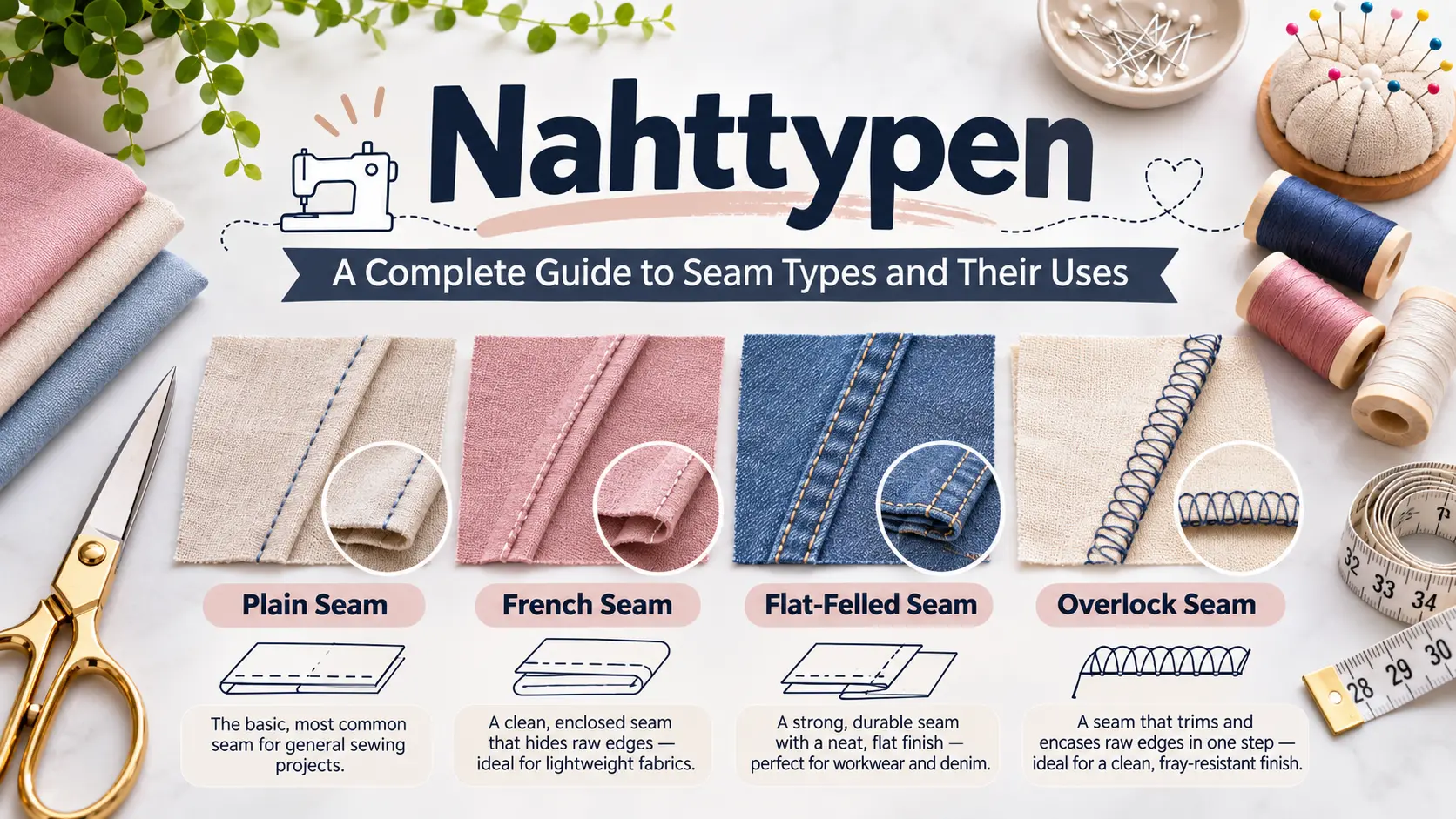
Nahttypen: A Complete Guide to Seam Types and Their Uses

Seams are an important part of almost every sewing project. Whether you are making a simple cotton shirt, a pair of jeans, or a beautiful dress, the seams help hold the fabric together and give the finished garment its shape. Choosing the right seam can also make clothing stronger, more comfortable, and more attractive.
The German word Nahttypen means “seam types” in English. It describes the different ways fabric pieces are joined or finished during sewing. Some seams are designed for strength, while others are used to hide raw edges, support stretchy fabrics, or create decorative details.
Learning about seam types is useful for beginners, home sewing enthusiasts, fashion designers, and clothing manufacturers. Understanding how each seam works can help you choose suitable techniques, prevent common sewing problems, and achieve cleaner results.
This guide explains the main types of Nahttypen, their common uses, advantages, limitations, and how to select the right seam for different fabrics and sewing projects.
What Are Nahttypen?
Nahttypen is a German term that refers to the different types of seams used in sewing and garment construction. A seam is formed when two or more pieces of fabric are joined together, usually with stitches made by hand or a sewing machine.
Seams are essential because they connect the different sections of clothing. For example, the sleeves, shoulders, and sides of a shirt are joined using seams. Without properly sewn seams, garments may lose their shape or come apart during normal use.
However, joining fabric is not their only purpose. Different seam constructions can also help prevent fraying, improve durability, reduce thickness, and create attractive finishes.
The type of seam used depends on several factors, including fabric weight, garment design, flexibility, and the amount of stress the seam must handle. A lightweight silk blouse may need a delicate seam, while heavy denim trousers usually require a stronger construction.
Another important sewing term is seam allowance. This is the distance between the stitching line and the cut edge of the fabric. Different seam techniques may require different allowance widths, so following your sewing pattern is important.
Understanding these basic details makes it easier to learn advanced sewing methods and select suitable seams for different materials.
Main Types of Seams Used in Sewing
There are many seam variations, but several basic types are commonly used in everyday sewing and professional clothing production. Each one has a different construction method and serves a specific purpose.
Some seam types are suitable for delicate fabrics, while others work better with heavy or stretchy materials. The following ten types cover many of the techniques used in garment construction.
1. Plain Seam
A plain seam is one of the simplest and most widely used seam types. It is often the first sewing technique beginners learn because it requires basic equipment and is easy to understand.
To make a plain seam, place two pieces of fabric with their right sides facing each other. Align the edges and sew along the required seam line. After stitching, press the seam allowances open or to one side, depending on the fabric and garment design.
Plain seams work well with many woven fabrics, including cotton, linen, and polyester. They are suitable for both straight and curved areas, making them useful for many clothing projects.
Common Uses: Plain seams are commonly used in shirts, dresses, skirts, trousers, pillowcases, and other everyday sewing projects.
Advantages: They are easy to construct, require basic sewing equipment, and work with many fabric types. They also provide a useful foundation for learning more advanced sewing techniques.
Limitations: The raw fabric edges may remain exposed after stitching. Materials that fray easily usually need an additional finish, such as zigzag stitching or overlocking.
Sewing Tip: Maintain a consistent seam allowance and press the fabric after sewing. This helps create a cleaner and more accurate finish.
2. French Seam
A French seam is a sewing technique that hides raw fabric edges inside the finished seam. It creates a neat appearance and is especially useful for lightweight or delicate materials.
Unlike a plain seam, a French seam requires two lines of stitching. First, the fabric pieces are sewn with their wrong sides together using a narrow seam allowance. The excess allowance is trimmed if needed, and the fabric is folded so the right sides face each other. A second line of stitching then encloses the raw edges.
This method produces a clean finish without leaving loose fabric threads visible inside the garment.
French seams are especially helpful when sewing transparent fabrics because unfinished edges can easily show through the material.
Common Uses: French seams are suitable for silk blouses, chiffon dresses, lightweight cotton garments, sheer curtains, and delicate clothing.
Advantages: They completely enclose raw edges, reduce fraying, and create an attractive interior finish without requiring a serger.
Limitations: They require more time and precision than plain seams. They may also become bulky when used with thick fabrics or difficult curves.
Sewing Tip: Test the technique on a small fabric sample before sewing your garment. Make sure the combined stitching allowances match the allowance required by your pattern.
3. Flat-Felled Seam
A flat-felled seam is a strong and durable construction commonly used in garments that experience regular movement, washing, and friction.
This seam is made by stitching fabric layers together, trimming one seam allowance, and folding the wider allowance around the trimmed edge. The folded section is then stitched down against the garment.
The finished seam encloses the raw fabric edges and usually creates two visible rows of stitching on the outside.
Flat-felled seams are commonly associated with denim clothing because they provide a secure finish and help protect the fabric edges from unraveling.
Common Uses: They are frequently used in jeans, work trousers, uniforms, cotton shirts, and durable workwear.
Advantages: Flat-felled seams offer good durability, protect raw edges, and create a neat, structured appearance.
Limitations: The additional folds may produce unwanted thickness in heavy fabrics. They also require careful stitching to keep the seam straight.
Sewing Tip: Press the folds before sewing and choose a needle suitable for the fabric weight. This can make thick layers easier to handle.
4. Lapped Seam
A lapped seam is created by overlapping one piece of fabric over another and securing the overlapping layers with stitching.
Unlike a plain seam, the fabric pieces do not need to be placed with their right sides facing each other. Instead, the edges overlap by a selected amount.
The overlapping section may be secured with one or more rows of stitches, depending on the strength and appearance required.
Lapped seams are useful for materials that are difficult to fold into conventional seams. They can also create decorative stitching details on the surface of a garment.
Common Uses: Lapped seams are used in leather clothing, denim, upholstery, bags, workwear, and selected industrial textile products.
Advantages: They can provide secure fabric connections, allow visible topstitching, and work well with certain heavy or non-fraying materials.
Limitations: Overlapping fabric layers can increase thickness. Uneven fabric placement may also affect the finished appearance.
Sewing Tip: Mark the overlap position before stitching. This helps keep the fabric layers properly aligned and creates a consistent finish.
5. Bound Seam
A bound seam uses a separate piece of fabric or binding tape to cover a fabric edge. Binding can also be applied to exposed seam allowances to give garments a cleaner interior finish.
The binding material is folded around the fabric edge and secured with stitching. Bias-cut binding is commonly used because it can follow curves more easily than straight-grain strips.
This method is useful when raw fabric edges need protection or when the inside of a garment will remain visible.
Binding can also become part of the garment’s design when contrasting colours or patterns are used.
Common Uses: Bound seams and bound finishes are found in unlined jackets, garment interiors, necklines, coats, and decorative sewing projects.
Advantages: They protect fabric edges, help reduce fraying, and provide a neat finish. Decorative binding can also improve the appearance of handmade clothing.
Limitations: Additional fabric and stitching are required. Thick binding may create bulk, particularly around curves or layered areas.
Sewing Tip: Choose lightweight binding that matches the thickness and flexibility of the main fabric.
6. Flat Seam
A flat seam connects fabric edges while keeping the finished join as smooth and thin as possible.
In many flat seam constructions, the fabric edges are placed together with little or no overlap and joined using suitable stitching. Special flat-seaming machines are often used in commercial garment production.
The main purpose is to reduce raised seam allowances that may rub against the skin.
This makes flat seams especially useful for fitted clothing and garments designed for movement.
However, a flat seam is not the same as a flat-felled seam. A flat-felled seam uses folded allowances, while a flat seam aims to create a low-bulk join.
Common Uses: Flat seams are commonly used in sportswear, thermal underwear, fitted exercise clothing, base layers, and performance garments.
Advantages: They reduce seam thickness, improve comfort, and can support flexible movement when suitable stitching is used.
Limitations: Certain constructions require specialist equipment. Incorrect stitching may reduce flexibility or cause the seam to break when stretched.
Sewing Tip: Test the finished seam by gently stretching the fabric. The stitching should move with the material without breaking.
7. Overlock Seam
An overlock seam is generally produced using an overlock sewing machine, also known as a serger.
The machine forms stitches around the fabric edge while typically trimming excess material. Depending on the machine settings, it can join fabric pieces and finish their raw edges in one operation.
Overlocking is especially popular for knitted and stretchy fabrics because appropriate stitch settings allow the seam to move with the material.
It is also widely used in commercial clothing production because it can make sewing faster and more efficient.
However, overlocking can be used for different purposes. Sometimes it joins fabric layers, while in other cases it only finishes the raw edge of an existing seam.
Common Uses: Overlock seams are widely used in T-shirts, leggings, sweatshirts, knitwear, sportswear, and casual clothing.
Advantages: They finish fabric edges quickly, help prevent unraveling, and work well with many stretch fabrics.
Limitations: A conventional overlock seam normally requires a serger. Incorrect machine settings may cause loose loops, stretched edges, or weak stitching.
Sewing Tip: Adjust the differential feed when working with stretch fabrics. This can help prevent the fabric from becoming wavy or gathered.
8. Hong Kong Seam Finish
A Hong Kong seam finish is a decorative sewing technique used to cover exposed seam allowances with narrow fabric strips.
Unlike some bound finishes that cover multiple layers together, this method normally finishes each seam allowance separately.
Lightweight bias-cut fabric is often used to create a smooth and attractive finish.
This technique is popular in tailored clothing because it makes the inside of a garment look neat without requiring a full lining.
A contrasting binding colour can also add an attractive decorative detail.
Common Uses: Hong Kong finishes are commonly used in unlined jackets, coats, tailored garments, handmade dresses, and visible garment interiors.
Advantages: They protect exposed edges, create a professional appearance, and offer decorative possibilities.
Limitations: They require extra fabric and sewing time. Poorly applied binding may result in uneven or bulky edges.
Sewing Tip: Use lightweight binding and press the finished edges carefully to create a smooth appearance.
9. Mock French Seam
A mock French seam creates a finish similar to a traditional French seam, but it uses a different construction process.
The method usually begins with a standard plain seam. After stitching, the raw seam allowances are folded inward and sewn together to enclose the edges.
This produces a neat interior finish without leaving raw fabric edges exposed.
Mock French seams can be useful when a traditional French seam is difficult to make, particularly on certain curved garment sections.
They are also a practical option for sewing projects that need enclosed edges but do not require a conventional French seam construction.
Common Uses: Mock French seams can be used in dresses, blouses, lightweight clothing, and selected curved garment sections.
Advantages: They hide raw edges, improve the appearance of garment interiors, and can be adapted to different sewing projects.
Limitations: Multiple folds may create additional thickness. The method also requires accurate folding and stitching.
Sewing Tip: Press both seam allowances inward before sewing them together. This helps create an even finish.
10. Self-Bound Seam
A self-bound seam uses the garment’s own fabric to enclose the raw seam allowances.
Unlike a bound finish that requires separate binding tape, this technique uses one of the existing seam allowances to cover the fabric edges.
To make a self-bound seam, one allowance is trimmed shorter, while the wider allowance is folded around it and stitched into position.
The finished seam creates a neat appearance using the same material as the garment.
This method is useful when additional binding fabric is unavailable or when a matching finish is preferred.
Common Uses: Self-bound seams are suitable for lightweight dresses, blouses, cotton garments, and selected handmade clothing projects.
Advantages: They hide raw edges, create a coordinated finish, and eliminate the need for separate binding material.
Limitations: The technique requires enough fabric allowance for folding. Thick fabrics may create unwanted bulk.
Sewing Tip: Make sure the wider seam allowance is large enough to cover the trimmed edge before stitching.
Comparison of Different Seam Types
The following table gives a quick overview of the ten seam types and their most common applications.
| Seam Type | Suitable Fabrics | Common Uses | Main Benefit |
|---|---|---|---|
| Plain Seam | Cotton, linen, polyester | Shirts, dresses, skirts | Easy construction |
| French Seam | Silk, chiffon, fine cotton | Delicate garments | Enclosed raw edges |
| Flat-Felled Seam | Denim, heavy cotton | Jeans, workwear | Strong and durable |
| Lapped Seam | Leather, denim | Bags, heavy garments | Secure overlapping join |
| Bound Seam | Light to medium fabrics | Jackets, necklines | Protected fabric edges |
| Flat Seam | Stretch fabrics | Activewear, underwear | Reduced seam bulk |
| Overlock Seam | Knits, jersey | T-shirts, leggings | Efficient edge finishing |
| Hong Kong Seam Finish | Woven fabrics | Unlined jackets, coats | Attractive interior |
| Mock French Seam | Lightweight woven fabrics | Dresses, blouses | Neat enclosed finish |
| Self-Bound Seam | Light to medium fabrics | Blouses, casual clothing | No separate binding needed |
These seam types serve different purposes. The most suitable option depends on how the fabric behaves, the appearance you want, and the amount of strength or flexibility the garment needs.
Classification of Seam Types According to ISO 4916
In professional textile manufacturing, seams are classified using internationally recognised standards. One important standard is ISO 4916:1991, which describes the classification and terminology of stitched seams.
This system focuses on how fabric pieces are arranged and joined rather than relying only on familiar sewing names.
ISO 4916 identifies eight broad seam classes. These classifications help designers, manufacturers, and quality inspectors describe sewing constructions more consistently.
For official information about the standard, you can visit the ISO 4916 seam classification page.
Eight Main Classes of Seams
| Seam Class | Classification | Description | Common Application |
|---|---|---|---|
| Class 1 | Superimposed Seams | Fabric layers are placed together and stitched near an edge. | Shirts, dresses, trousers |
| Class 2 | Lapped Seams | Fabric sections overlap and are secured with stitching. | Denim, workwear, leather products |
| Class 3 | Bound Seams | A binding component covers and secures a material edge. | Bound garment edges, necklines |
| Class 4 | Flat Seams | Fabric edges are joined with little or no overlap. | Underwear, fitted clothing |
| Class 5 | Decorative Stitching | Stitching creates ornamental effects on fabric. | Decorative panels, garment details |
| Class 6 | Edge Finishing | Stitching secures or finishes exposed edges. | Overlocked edges, seam allowances |
| Class 7 | Attaching Separate Items | Additional components are attached to a material edge. | Elastic and garment component attachment |
| Class 8 | Single-Ply Construction | Stitching or folding is performed on a single material layer. | Selected hems and fabric details |
These classes are useful because two seams may look similar but use different construction methods.
For example, a plain seam belongs to the superimposed seam category because fabric layers are placed together before stitching. A lapped seam, however, uses overlapping fabric sections.
It is also important to understand that the same sewing machine may be used for different seam constructions. For example, an overlock machine can join suitable fabric layers or simply finish an exposed edge.
In clothing manufacturing, seam classification is often considered alongside stitch type, thread selection, and fabric properties. Together, these details help manufacturers maintain consistent garment quality.
Difference Between Seam Types and Stitch Types
Seam types and stitch types are related, but they do not mean the same thing.
A seam type describes how pieces of fabric are arranged, joined, or finished. A stitch type describes how sewing threads form loops or interlock to secure the fabric.
For example, a plain seam is a seam construction, while a lockstitch is a type of stitch that may be used to create it.
Similarly, overedge stitching can be used to join fabric layers or finish raw edges, depending on the sewing method.
Understanding this difference is useful when following sewing patterns, adjusting machine settings, or learning professional garment construction.
| Feature | Seam Type | Stitch Type |
|---|---|---|
| Meaning | Arrangement used to join or finish fabric | Formation of sewing thread stitches |
| Main Purpose | Connect or finish material | Secure material with thread |
| Examples | Plain, French, lapped, flat-felled | Lockstitch, chainstitch, overedge |
| Main Focus | Fabric arrangement | Thread formation |
| Selection Depends On | Fabric, garment design, durability | Machine, thread, flexibility |
| ISO Classification | ISO 4916 | ISO 4915 |
Both are important for successful sewing.
A suitable seam construction may still fail if the stitching cannot handle the fabric’s movement. For example, fitted knit garments need stitching that can stretch without breaking.
In simple words, the seam determines how the fabric is joined, while the stitches hold that construction together.
How to Choose the Right Seam Type
Choosing the right seam depends on the fabric, garment design, intended use, and available sewing equipment.
A seam that works well for denim may not suit lightweight silk. Similarly, a seam designed for delicate clothing may not provide enough durability for heavy workwear.
Before starting a sewing project, consider the following factors.
1. Consider the Fabric Type
Fabric type is one of the most important factors when selecting a seam.
Lightweight materials usually need narrow, carefully finished seams. Heavy fabrics often require stronger stitching and constructions that can handle thicker layers.
Stretch fabrics need flexible seams because rigid stitching may break when the material stretches.
The table below provides general recommendations for common fabrics.
| Fabric Type | Recommended Seam | Reason |
|---|---|---|
| Lightweight Cotton | Plain or French seam | Simple construction and neat finishing |
| Silk | French seam | Protects delicate raw edges |
| Chiffon | French seam | Creates a clean interior finish |
| Denim | Flat-felled seam | Provides durable construction |
| Linen | Plain seam with edge finish | Helps control fraying |
| Jersey Knit | Overlock seam | Supports flexible construction |
| Activewear Fabric | Flat or suitable overlock seam | Improves comfort and movement |
| Leather | Suitable lapped seam | Reduces the need for bulky folded joins |
| Unlined Wool Jacket | Plain seam with Hong Kong finish | Creates an attractive interior |
These are general guidelines rather than fixed rules. Always test the chosen seam on spare fabric before sewing the final garment.
2. Consider Durability
Some garments need stronger seams because they experience frequent movement, pulling, washing, or friction.
Jeans, work trousers, uniforms, and bags often require durable seam constructions.
Flat-felled seams are useful in many heavy-duty garments because their folded structure protects the fabric edges and provides a secure connection.
However, strength does not depend on the seam type alone. Thread quality, stitch length, fabric strength, and sewing accuracy also affect durability.
For areas that experience regular stress, choose a construction that provides enough strength without damaging the surrounding fabric.
3. Consider Comfort
Comfort matters most when clothing is worn close to the skin.
Bulky seams may cause rubbing or discomfort in fitted garments, underwear, and sportswear.
Flat seams are useful in these situations because they reduce raised fabric layers. Suitable overlock stitching can also provide flexibility in knit garments.
Seam placement is another important factor. Even a well-made seam may feel uncomfortable if it sits directly against an area that experiences constant pressure or movement.
For comfortable clothing, choose a construction that matches the fabric and allows natural movement.
4. Consider Appearance
Seams can affect both the inside and outside appearance of a garment.
Some techniques create nearly hidden joins, while others produce visible stitching that becomes part of the design.
French seams create a neat interior without exposed edges. Flat-felled seams often produce visible parallel stitching, giving denim clothing a structured appearance.
Hong Kong finishes are useful when the inside of an unlined jacket needs to look attractive.
Before selecting a seam, consider whether it will remain visible and how it will affect the finished garment’s overall appearance.
5. Consider Available Equipment
Not every seam requires specialist sewing equipment.
Many basic seams can be made with a standard domestic sewing machine. Plain seams, French seams, and mock French seams are practical options for home sewing.
Other constructions may be easier or more efficient with specialised machinery.
For example, a serger is designed to produce overlock stitching, while certain flat seams require specialised equipment.
The following table shows common sewing equipment and its applications.
| Sewing Equipment | Common Applications | Main Benefit |
|---|---|---|
| Domestic Sewing Machine | Plain, French, mock French seams | Suitable for general sewing |
| Serger or Overlock Machine | Knit seams, edge finishing | Fast joining and finishing |
| Flat-Seaming Machine | Selected performance garment seams | Produces low-bulk joins |
| Industrial Straight-Stitch Machine | General garment construction | Efficient production |
| Hand Sewing Needle | Small repairs and detailed finishing | Useful for precise handwork |
If you are a beginner, start with techniques that work with your current equipment.
Learning to sew accurate seams is more important than using expensive machinery. Once you understand basic techniques, you can gradually explore more advanced constructions.
Common Seam Problems and How to Avoid Them
Even the right seam can produce poor results if it is not sewn correctly.
Many common sewing problems happen because of unsuitable needles, incorrect thread tension, uneven fabric feeding, or poor preparation.
Understanding these problems will help you improve your sewing results and avoid unnecessary fabric waste.
Uneven Stitching
Uneven stitching occurs when the seam line becomes crooked or the stitch length changes unexpectedly.
This problem often happens when fabric is pulled through the sewing machine, the sewing speed changes suddenly, or the fabric is not guided correctly.
To avoid uneven stitching, maintain a steady sewing speed and guide the fabric gently without forcing it.
Use the seam guide on your machine to keep the stitching line consistent. Checking the needle, presser foot, and machine settings can also help improve stitch quality.
Fabric Puckering
Fabric puckering happens when small wrinkles or gathered areas appear along a stitched seam.
It is especially common when sewing lightweight fabrics or materials that are sensitive to thread tension.
Possible causes include excessive tension, an unsuitable needle, incorrect stitch length, or uneven fabric feeding.
To reduce puckering, test different machine settings and choose a needle suitable for the material.
Avoid pulling the fabric while sewing, and press the material carefully before stitching.
Fraying Edges
Fraying occurs when threads begin to separate from the cut edges of woven fabric.
Some materials, including loosely woven linen, may fray more easily than tightly woven fabrics.
If raw edges are left unfinished, the fabric may continue to unravel during washing and wearing.
To prevent this problem, choose a suitable edge-finishing technique.
French seams can enclose raw edges, while overlocking and zigzag stitching help secure them. Binding is another useful option when a neat finish is required.
Weak Seams
Weak seams may open, stretch out of shape, or break during normal use.
This can happen when the stitch type does not suit the fabric, the thread is too weak, or the seam allowance is too narrow.
Areas that experience frequent movement may require additional reinforcement.
Choose suitable thread and stitching, maintain consistent seam allowances, and reinforce sections where extra strength is needed.
Testing a finished seam by applying gentle pressure can also help identify possible weaknesses before the garment is completed.
Excessive Seam Bulk
Excessive seam bulk occurs when too many fabric layers are folded or joined in one area.
This problem is common in thick hems, collars, waistbands, and heavy garments.
Too much thickness can prevent seams from lying smoothly and may make clothing uncomfortable.
To reduce bulk, trim unnecessary fabric carefully and grade seam allowances where appropriate.
Grading involves cutting layered seam allowances to different widths so they do not create one thick edge.
Pressing the seam correctly can also help create a flatter finish.
Quick Guide to Common Seam Problems
| Problem | Possible Cause | Practical Solution |
|---|---|---|
| Uneven Stitching | Poor fabric guidance | Sew steadily and use the seam guide |
| Fabric Puckering | Incorrect tension or unsuitable needle | Adjust settings and test on spare fabric |
| Fraying Edges | Exposed raw fabric edges | Use overlocking, binding, or enclosed seams |
| Weak Seams | Unsuitable stitching or thread | Choose a suitable construction and reinforce stress areas |
| Excessive Bulk | Too many folded layers | Trim, grade, and press seam allowances |
| Broken Stitches | Insufficient stretch | Use stitching suited to the fabric |
| Wavy Knit Seams | Fabric stretching during sewing | Adjust differential feed or fabric handling |
Testing a seam before beginning the main project is one of the easiest ways to prevent these problems.
A small fabric sample can reveal issues with thread tension, stitch quality, seam thickness, and overall appearance.
Importance of Nahttypen in Clothing Manufacturing
Nahttypen play an important role in clothing manufacturing because seam selection affects garment durability, comfort, appearance, and production efficiency.
In professional garment production, clothing passes through several stages, including fabric cutting, sewing, assembly, finishing, and quality checking.
The type of seam used can influence how easily these stages are completed and how well the finished product performs.
For example, a factory producing cotton T-shirts may use overlock machines to join suitable fabric edges quickly. A denim manufacturer may use flat-felled seams in areas that need additional durability.
Manufacturers of tailored jackets may choose decorative seam finishes to improve the appearance of visible garment interiors.
Different products require different seam constructions because they are designed for different purposes.
Fashion design involves more than choosing attractive fabrics. Designers must also consider garment construction, comfort, and the finished appearance. Influential designers such as Diane von Furstenberg have helped shape the fashion industry through their clothing designs.
Copy text
| Clothing Product | Common Seam Choice | Main Priority |
|---|---|---|
| Cotton Shirts | Plain or flat-felled seam | Comfort and neat construction |
| Denim Jeans | Flat-felled or lapped seam | Durability and strength |
| Sportswear | Flat or overlock seam | Flexibility and comfort |
| Delicate Dresses | French seam | Clean finishing |
| Unlined Jackets | Plain seam with bound finish | Attractive interior |
| Knit T-Shirts | Overlock seam | Efficient and flexible construction |
| Work Uniforms | Reinforced plain or flat-felled seam | Resistance to regular wear |
Seam selection also affects manufacturing costs and production time.
Some techniques require several sewing operations, while others allow fabric joining and edge finishing to be completed together.
A complicated seam may require additional thread, labour, or specialised equipment. Manufacturers must therefore balance strength, appearance, comfort, and production efficiency.
Quality control is another important part of seam construction.
During garment inspection, manufacturers may check stitching consistency, seam strength, alignment, exposed fabric edges, and overall appearance.
Using recognised seam classifications also helps designers and production teams communicate sewing requirements more clearly.
For home sewing enthusiasts, these same principles are useful on a smaller scale. Choosing the correct seam and sewing it carefully can make handmade garments look more professional and last longer.
Frequently Asked Questions About Nahttypen
What does Nahttypen mean in English?
Nahttypen is a German term that means “seam types” in English. It describes the different methods used to join, construct, or finish fabric during sewing and textile manufacturing.
What are the most common seam types?
Common seam types include plain seams, French seams, flat-felled seams, lapped seams, bound seams, flat seams, and overlock seams. Each serves a different purpose depending on the fabric, garment design, and required strength.
Which seam is best for beginners?
A plain seam is usually the easiest choice for beginners. It requires basic sewing equipment and can be used in many everyday projects. Once you can sew a consistent plain seam, you can begin practising French seams and other techniques.
Which seam is best for lightweight fabrics?
French seams are often suitable for lightweight fabrics such as silk, chiffon, and fine cotton. They enclose raw edges and create a neat interior finish. However, the right choice also depends on the garment design and fabric structure.
Which seam is strongest for jeans?
Flat-felled seams are commonly used in jeans because they create durable connections and enclose raw fabric edges. The actual strength also depends on the denim, thread, stitching, and quality of construction.
What is the difference between a French seam and a flat-felled seam?
A French seam hides raw fabric edges inside a folded construction and is often used for delicate materials. A flat-felled seam also encloses raw edges but secures the folded allowances against the garment, usually creating visible parallel stitching. Flat-felled seams are commonly used in denim and durable clothing.
How many seam classes does ISO 4916 define?
ISO 4916:1991 identifies eight broad classes of stitched seams. These include superimposed seams, lapped seams, bound seams, flat seams, decorative stitching, edge finishing, attaching separate items, and single-ply construction.
Why are different seam types important?
Different seam types provide different benefits. They can improve garment strength, prevent fraying, reduce seam thickness, increase comfort, and create attractive finishes. Choosing the correct seam helps clothing perform better during regular use.
Conclusion
Understanding Nahttypen is an important part of learning sewing and garment construction. Different seam types serve different purposes, from joining basic fabric pieces to creating durable clothing and neatly finished garment interiors.
Plain seams are a practical starting point for beginners, while French seams work well for many delicate fabrics. Flat-felled seams are useful for durable garments, and suitable overlock or flat seams can provide comfort and flexibility in stretch clothing. Bound seams and other specialised finishes offer additional ways to protect fabric edges and improve appearance.
The right seam is not always the most complicated one. It is the technique that matches your fabric, sewing equipment, garment design, and intended use.
By understanding these methods and practising them carefully, you can create stronger, neater, and more comfortable sewing projects with greater confidence.
Explore more helpful articles, informative guides, and interesting topics on our AllPrayerHub Blog.
