
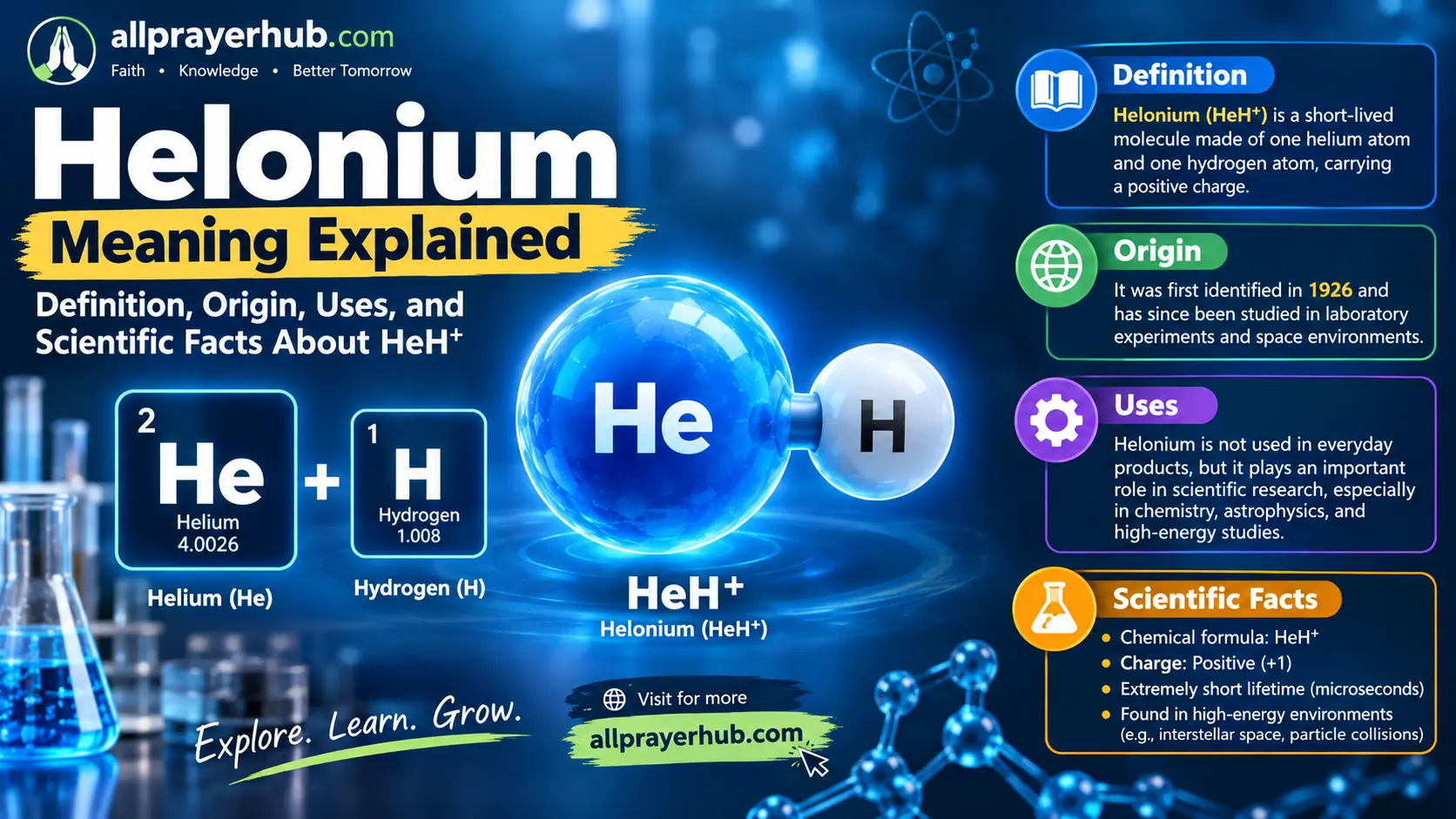
Helonium Meaning Explained: Definition, Origin, Uses, and Scientific Facts About HeH⁺

The word Helonium attracts curiosity because it sounds similar to familiar words like helium, but its actual meaning is connected to advanced chemistry and astronomy. Many people search for terms like HELONIUM Connections, Helonium nyt connections, Helonium synonym, and Helonium meaning slang because they want to understand whether Helonium is a chemical substance, a new element, or something else.
In scientific terms, Helonium refers to the Helium Hydride Ion (HeH⁺). It is a very simple but extremely important molecule made from one helium atom and one hydrogen atom. Unlike ordinary helium, which is famous for being chemically inactive, Helonium shows that helium can form a chemical bond under special conditions.
Scientists consider Helonium one of the most fascinating molecules because it is believed to be one of the first molecular structures formed after the Big Bang. Soon after the universe began, only a few simple elements existed. The formation of molecules like HeH⁺ was an important step toward the development of more complex chemistry that eventually created stars, planets, and life-supporting environments.
Although Helonium is not commonly found around us on Earth, it plays an important role in scientific research. Astronomers study this ion to understand the chemistry of the early universe and how the first molecules appeared billions of years ago.
This article explains everything about Helonium meaning, definition, formation, discovery, properties, uses, common misconceptions, and related searches in simple and easy language.
What Does Helonium Mean?
The term Helonium refers to a chemical ion known scientifically as the Helium Hydride Ion, written as HeH⁺.
To understand the meaning, it helps to break down the name:
- Helium (He): A noble gas that is normally very stable and does not easily react with other elements.
- Hydrogen (H): The lightest chemical element and one of the most common elements in the universe.
- Ion (+): A particle that carries an electrical charge.
When a helium atom combines with a hydrogen ion, it creates HeH⁺, which is a positively charged molecule.
In simple words:
Helonium is a charged molecule made of helium and hydrogen that forms under special conditions, especially in space.
It is important to understand that Helonium is not a separate element. It is a combination of existing elements that creates a unique molecular ion.
The word Helonium may also appear in different online searches because people are trying to find different meanings. For example, some users search Helonium synonym to discover alternative names, while others search Helonium meaning slang to check whether the word has a non-scientific meaning. In chemistry, however, the accepted meaning refers to the helium hydride ion.
What Is Helonium? Meaning Explained in Simple Words
In simple terms, Helonium is one of the smallest and oldest known molecules in the universe.
Imagine two different atoms:
- A helium atom
- A hydrogen atom
Under normal conditions, helium prefers to remain alone because it has a complete outer electron shell, making it highly stable. However, in extreme environments with high energy, hydrogen can interact with helium and create a new structure called HeH⁺.
This molecule has:
- One helium atom
- One hydrogen atom
- A positive electrical charge
Unlike helium gas used in balloons, Helonium is not something that can be collected and stored easily. It is highly reactive and usually exists only for a short period before interacting with other particles.
A simple comparison:
| Substance | Simple Explanation |
|---|---|
| Helium | A stable gas commonly used in balloons |
| Hydrogen | The lightest element and a major part of stars |
| Helonium (HeH⁺) | A charged molecule made from helium and hydrogen |
The importance of Helonium does not come from everyday uses. Instead, its value comes from what it tells scientists about the history of the universe.
Helonium Meaning in English: A Complete Definition
The scientific definition of Helonium is:
Helonium is a positively charged molecular ion consisting of a helium atom bonded with a hydrogen atom. It is considered one of the earliest molecules formed in the universe after the Big Bang.
Unlike normal chemical compounds found on Earth, Helonium exists mainly in environments where there is intense radiation, high energy, and very low density.
Some important characteristics of Helonium include:
- It has the chemical formula HeH⁺.
- It contains helium and hydrogen.
- It carries a positive charge.
- It is classified as a molecular ion.
- It is mainly studied in astrophysics and chemistry research.
The discovery of Helonium changed scientists’ understanding of helium. For a long time, helium was considered almost completely non-reactive. The existence of HeH⁺ proved that even very stable elements can participate in chemical reactions under the right conditions.
Is Helonium a Chemical Element or Something Else?
One of the most common questions about Helonium is whether it is a new chemical element.
The answer is no.
Helonium is not listed on the periodic table because it is not an element. It is a molecular ion, meaning it is made by joining atoms from different elements and carrying an electrical charge.
To understand the difference:
| Category | Meaning | Example |
|---|---|---|
| Chemical Element | Made of only one type of atom | Helium (He), Hydrogen (H) |
| Molecule | Two or more atoms joined together | Water (H₂O) |
| Molecular Ion | A molecule with an electrical charge | Helonium (HeH⁺) |
Helonium contains two different atoms:
- Helium
- Hydrogen
Because of this, it cannot be considered an element.
This misunderstanding happens because the name “Helonium” sounds like names of elements such as helium, lithium, or sodium. However, the ending of a word does not determine whether something is an element. Its chemical structure decides its classification.
Helonium vs Helium: What Is the Difference?
Because their names are very similar, Helonium and helium are often confused. However, they are completely different substances.
Helium is a naturally occurring element that exists on Earth and throughout the universe. It is commonly known for being used in balloons, scientific equipment, and cooling systems.
Helonium, on the other hand, is a rare molecular ion that forms when helium reacts with hydrogen under specific conditions.
| Feature | Helium | Helonium (HeH⁺) |
|---|---|---|
| Chemical formula | He | HeH⁺ |
| Type | Element | Molecular ion |
| Electrical charge | Neutral | Positive charge |
| Stability | Very stable | Highly reactive |
| Common location | Earth, stars, atmosphere | Space environments |
| Scientific importance | Used in many applications | Helps study early universe chemistry |
The main difference is that helium exists as individual atoms, while Helonium is a combination of helium and hydrogen atoms.
Another important difference is their behavior:
- Helium usually avoids chemical reactions.
- Helonium forms through chemical bonding.
- Helium can exist naturally in large amounts.
- Helonium is difficult to detect because it is unstable.
Understanding this difference helps avoid confusion between these two similarly named substances.
HELONIUM Connections: How Is It Related to Helium, Hydrogen, and Astronomy?
The search term HELONIUM Connections usually relates to understanding how Helonium connects with other scientific concepts. Helonium has strong connections with helium chemistry, hydrogen reactions, and the study of the universe.
Connection Between Helonium and Helium
The strongest connection is with helium because helium is one of the two atoms that create HeH⁺.
For many years, scientists believed helium was almost completely unable to form chemical bonds because of its stable electron structure. The existence of Helonium showed that helium can react when placed in special environments.
This discovery helped scientists understand that chemical behavior depends on conditions such as:
- Energy levels
- Temperature
- Radiation
- Surrounding particles
Connection Between Helonium and Hydrogen
Hydrogen is the other important component of Helonium.
In the early universe, hydrogen was one of the first elements available after the Big Bang. When hydrogen ions interacted with helium atoms, they produced HeH⁺.
This reaction was an important early chemical process because it allowed the universe to move from simple atoms toward more complex molecules.
Connection Between Helonium and Astronomy
Helonium is strongly connected with astronomy because it helps researchers study:
- The early universe
- Formation of the first molecules
- Planetary nebulae
- Chemical evolution of space
Astronomers study HeH⁺ because its presence provides clues about conditions that existed billions of years ago.
How Is Helonium Formed? Understanding HeH⁺ Formation
Helonium, scientifically known as the Helium Hydride Ion (HeH⁺), is formed when helium and hydrogen interact under very specific conditions. Since helium is one of the most stable elements, creating a bond with it is not easy. It requires a high-energy environment where hydrogen can lose an electron and become a positively charged ion.
The basic formation process can be written as:
He + H⁺ → HeH⁺
This means:
- A helium atom (He) combines with a hydrogen ion (H⁺).
- The result is a positively charged Helonium molecule (HeH⁺).
This process does not usually happen in normal conditions on Earth. Instead, it occurs in places where there is strong radiation, high temperatures, or energetic particles.
Scientists study Helonium formation because it provides information about how the first molecules developed after the beginning of the universe.
Formation in the Laboratory
Scientists first created Helonium in laboratory conditions to study its unusual chemical behavior.
The laboratory formation of HeH⁺ requires controlled environments where researchers can bring helium and hydrogen ions together. Because Helonium is highly reactive, it cannot simply be stored like ordinary gases.
Researchers use advanced equipment to:
- Create hydrogen ions.
- Introduce them into helium gas.
- Observe the chemical reaction.
- Study the structure and behavior of the resulting HeH⁺ molecule.
Laboratory studies helped scientists understand:
- How helium can form chemical bonds.
- How the molecule behaves.
- Why it is important in cosmic chemistry.
Although Helonium can be produced artificially, it is difficult to maintain because it quickly reacts with other substances.
Formation in Space
The most important formation of Helonium happens naturally in space.
After the Big Bang, the universe was extremely hot and filled mainly with simple elements such as hydrogen and helium. As the universe cooled, atoms began interacting and creating the first molecules.
Scientists believe Helonium formed when:
- Helium atoms were present in the early universe.
- Hydrogen existed as positively charged ions.
- Energy conditions allowed these particles to combine.
This made HeH⁺ one of the earliest molecular structures created after the universe began.
In modern space environments, Helonium can form in areas such as:
- Planetary nebulae
- Regions with strong ultraviolet radiation
- Hot areas around stars
These environments provide the energy needed for helium and hydrogen to interact.
When Was Helonium Discovered? History and Scientific Background
The history of Helonium is interesting because scientists knew about its existence long before they detected it in space.
The Helium Hydride Ion was first produced in a laboratory in 1925. Researchers discovered that helium, despite being considered chemically inactive, could form a bond with hydrogen under suitable conditions.
This discovery was surprising because helium belongs to the noble gas family. Noble gases are known for being extremely stable and usually do not combine with other elements.
For many decades, scientists believed that HeH⁺ should exist naturally in space, especially because conditions after the Big Bang were suitable for its formation. However, detecting it was extremely difficult.
The problem was that Helonium is:
- Very reactive.
- Present in small amounts.
- Difficult to observe using traditional instruments.
Scientists searched for signs of HeH⁺ in space for many years before finally confirming its existence.
The Space Discovery in 2019
In 2019, astronomers made an important breakthrough by detecting Helonium in space for the first time.
Researchers found HeH⁺ in the NGC 7027 planetary nebula, a cloud of gas surrounding a dying star. The discovery was made using the SOFIA (Stratospheric Observatory for Infrared Astronomy) telescope.
This was a major scientific achievement because it confirmed a theory that had existed for decades: the first molecule of the universe could still exist in modern space environments.
The detection of Helonium helped scientists better understand:
- How early chemistry developed after the Big Bang.
- How molecules survive in space.
- How stars and planetary systems evolve.
The 2019 discovery was especially important because it connected modern astronomical observations with events that happened billions of years ago.
Helonium in Space: Why Scientists Study This Ion
Helonium is mainly studied because it provides a window into the chemistry of the universe.
Although HeH⁺ is a very simple molecule, it carries important information about cosmic history.
Scientists study Helonium to understand:
Early Universe Chemistry
After the Big Bang, the universe contained mostly simple atoms. Molecules like HeH⁺ were among the first chemical structures to appear.
By studying this ion, researchers can understand how the universe changed from a collection of atoms into a place where complex molecules could form.
Star Formation
Stars form inside large clouds of gas and dust. Chemical reactions in these regions influence how stars develop.
Helonium helps researchers understand the conditions that exist around young and old stars.
Planetary Nebulae
Planetary nebulae are clouds of gas created when stars reach the end of their life.
The discovery of Helonium in NGC 7027 showed that this molecule can survive in certain astronomical environments.
Why Is Helonium Important in Astronomy and the Early Universe?
The importance of Helonium comes from its connection to the earliest moments of cosmic history.
Scientists believe that shortly after the Big Bang, the universe contained mainly:
- Hydrogen
- Helium
- Small amounts of other simple elements
Before complex molecules could exist, the first chemical bonds had to form. Helonium was one of the earliest examples of this process.
Its importance can be explained in three main ways:
1. It Shows How Chemistry Began
Helonium represents one of the first steps from simple atoms toward complex chemistry.
Without early molecules, the development of stars, planets, and life-supporting environments would have followed a different path.
2. It Helps Test Scientific Models
Scientists create computer models to understand how the early universe developed.
The presence of HeH⁺ helps researchers check whether these models correctly explain early chemical reactions.
3. It Improves Our Understanding of Space
Every molecule found in space provides information about the conditions where it formed.
Helonium helps scientists learn about:
- Temperature changes
- Radiation levels
- Chemical processes in space
Does Helonium Exist Naturally on Earth?
Helonium is not commonly found naturally on Earth.
Unlike helium gas, which exists in the atmosphere and underground deposits, HeH⁺ is extremely rare because it is highly reactive.
On Earth, Helonium quickly reacts with other molecules and breaks apart. This makes it difficult to observe outside controlled laboratory environments.
However, scientists can create and study it using special equipment.
The main difference is:
| Substance | Presence on Earth |
|---|---|
| Helium | Naturally found and widely used |
| Hydrogen | Common element found in many compounds |
| Helonium (HeH⁺) | Rare and mainly studied in laboratories |
Although Helonium is rare on Earth, it is scientifically valuable because of its role in understanding space chemistry.
Chemical Properties of Helonium (HeH⁺)
Helonium has several unique chemical properties that make it interesting to researchers.
The molecule is extremely simple, but its behavior is unusual because it involves helium, an element known for resisting chemical reactions.
Some important chemical properties include:
- It has a positive electrical charge.
- It contains one helium atom and one hydrogen atom.
- It forms through ionic bonding interactions.
- It is highly reactive.
- It exists mainly under special conditions.
Because of its reactive nature, Helonium does not remain stable for long periods in normal environments.
Important Chemical Properties of Helonium
Helonium, or Helium Hydride Ion (HeH⁺), has several unusual chemical properties that make it important for scientists. Although the molecule is very small, it behaves differently from many common substances because it contains helium, an element that is normally considered extremely stable.
Some important chemical properties of Helonium include:
1. Positive Electrical Charge
The most important feature of Helonium is that it carries a positive charge.
The symbol HeH⁺ shows that the molecule has lost an electron and exists as a positively charged ion. This positive charge affects how it reacts with other molecules.
2. Strong Chemical Bond
Helonium contains a strong bond between helium and hydrogen. This is surprising because helium usually does not form bonds with other elements.
The existence of HeH⁺ proves that even stable elements can participate in chemical reactions under the right conditions.
3. Highly Reactive Nature
Unlike helium gas, which is very stable, Helonium is highly reactive.
It quickly interacts with other molecules and can break apart when conditions are not suitable. This is one reason why studying and detecting it is challenging.
4. Strong Acidity
Helonium is considered one of the strongest known acids because it can easily donate a proton (H⁺) to other molecules.
This property makes it useful for studying chemical reactions, especially in extreme environments.
5. Short Existence Time
Helonium does not usually remain stable for long periods. Once formed, it can react with other particles and transform into different substances.
Because of this, scientists need advanced instruments to detect and study it.
Physical Properties and Behavior of Helonium
The physical behavior of Helonium is different from ordinary gases like helium and hydrogen.
Some key physical characteristics include:
| Property | Description |
|---|---|
| Chemical Formula | HeH⁺ |
| Type | Molecular ion |
| Charge | Positive (+1) |
| Components | Helium and hydrogen |
| Appearance | Not visible as a normal gas |
| Main Location | Space environments |
| Stability | Exists under specific conditions |
Unlike helium, Helonium cannot be stored in a container for everyday use. It is not a gas that people can see or handle directly.
Its existence depends on environmental conditions such as:
- High energy levels
- Radiation
- Low-density environments
- Presence of hydrogen ions
In space, these conditions naturally occur around stars and planetary nebulae, allowing Helonium to exist.
What Are the Uses of Helonium?
When people search Helonium uses, they often expect it to have commercial applications like helium. However, Helonium does not have common industrial uses because it is extremely unstable and difficult to maintain.
Its importance is mainly scientific.
The major uses of Helonium include:
1. Astronomy Research
One of the biggest uses of Helonium is in astronomy.
Scientists study HeH⁺ to understand:
- How the first molecules formed after the Big Bang.
- How chemical reactions happen in space.
- How stars and planetary systems develop.
The presence of Helonium acts like a chemical clue that helps researchers understand ancient cosmic events.
For astronomers, finding HeH⁺ is similar to finding evidence from the early history of the universe.
2. Studying Early Universe Chemistry
Helonium is extremely important for studying the beginning of the universe.
After the Big Bang, the universe was filled with simple atoms. Before complex molecules could form, the first chemical reactions had to take place.
Scientists believe Helonium was one of the earliest molecules created.
By studying this ion, researchers can learn:
- How atoms combined for the first time.
- How the first chemical processes started.
- How the universe changed over billions of years.
This makes Helonium valuable in cosmology and astrophysics.
3. Laboratory Chemistry
Although Helonium is not used in everyday products, it is valuable in laboratory research.
Scientists create HeH⁺ under controlled conditions to study:
- Chemical bonding
- Ion reactions
- Molecular behavior
- Extreme chemistry
Research on Helonium also helps scientists understand how other unusual molecules behave in extreme environments.
Is Helonium Used in Medicine or Industry?
No, Helonium is not currently used in medicine or commercial industries.
Some people confuse Helonium with helium because helium has many practical uses. For example, helium is used in:
- Medical imaging equipment
- Scientific cooling systems
- Welding applications
- Research laboratories
However, Helonium is completely different.
Because HeH⁺ is:
- Difficult to produce,
- Highly reactive,
- Hard to store,
it does not have practical applications like helium.
Its value is mainly related to scientific research rather than commercial production.
Helium Uses
Since Helonium is often confused with helium, it is useful to understand the common uses of helium.
Helium is a widely used element with many practical applications.
Some major helium uses include:
Medical Applications
Helium is used in some medical technologies, including cooling systems for certain medical equipment.
Scientific Research
Scientists use helium in experiments that require extremely low temperatures.
Industrial Applications
Helium is used in:
- Leak detection systems
- Welding environments
- Manufacturing processes
Balloons and Entertainment
One of the most familiar uses of helium is filling balloons because it is lighter than air.
Helonium Uses
The term Helonium uses is searched by many users who want to know whether it has applications similar to helium.
However, Helonium does not have everyday uses.
The main Helonium uses are:
| Use Area | Purpose |
|---|---|
| Astronomy | Studying molecules in space |
| Cosmology | Understanding early universe chemistry |
| Laboratory Research | Studying chemical bonding and reactions |
Unlike helium, Helonium is not used in products, medicine, or industrial systems.
Its importance comes from scientific discovery rather than practical applications.
Helonium Pronunciation, Synonyms, and Common Names
Many people search for Helonium synonym because the word is unfamiliar and they want to know other names used for the same substance.
The most common scientific names for Helonium are:
- Helium Hydride Ion
- Helium Hydride Cation
- HeH⁺ Ion
- Helium Hydrogen Ion
- First Molecular Ion of the Universe
The scientifically accepted name is Helium Hydride Ion (HeH⁺).
The word “Helonium” is a simpler way to refer to this molecule, but researchers usually use the formal chemical name.
Helonium Synonym: Alternative Names Explained
The term Helonium synonym usually refers to other names that describe the same molecule.
Common alternatives include:
Helium Hydride Ion
This is the most widely accepted scientific name.
Helium Hydride Cation
The word “cation” means a positively charged ion, which describes the + charge of HeH⁺.
HeH⁺
This is the chemical formula used by scientists.
First Molecular Ion
This name highlights its importance as one of the earliest molecules formed in the universe.
These names refer to the same scientific substance, not different materials.
Helonium Pronunciation and Common Naming Confusion
The pronunciation of Helonium is usually straightforward, but people often confuse it with helium because of the similar spelling.
The main difference is:
- Helium refers to the element He.
- Helonium refers to the molecule HeH⁺.
The similarity in names is the main reason many people search questions like:
- “What does Helonium mean?”
- “Is Helonium the same as helium?”
- “Helonium synonym”
Understanding the scientific definition removes this confusion.
Why Is Helonium Often Confused With Helium?
One of the main reasons people confuse Helonium with helium is their similar names. Both words begin with “Heli-” because they are related to helium, but they describe completely different things.
Helium is a chemical element with the symbol He, while Helonium refers to the Helium Hydride Ion (HeH⁺), which is a molecule made from helium and hydrogen.
The confusion usually happens because:
- Both names contain the word “helium”.
- Helonium contains helium as one of its components.
- Many people assume that anything starting with “heli-” must be an element.
However, the difference is simple:
Helium is an element, while Helonium is a molecular ion.
Helium exists naturally around us and is commonly used in balloons, scientific equipment, and industrial applications. Helonium, on the other hand, is mostly studied by scientists because of its role in space chemistry and the early universe.
Understanding this difference helps explain why Helonium is scientifically interesting but does not have the same practical uses as helium.
Common Misconceptions About Helonium
Because Helonium is a less familiar term, several misunderstandings exist about it. Let’s look at some common misconceptions.
1. Helonium Is a New Chemical Element
This is one of the most common mistakes.
Helonium is not a new element and does not have its own place on the periodic table.
The periodic table contains individual elements such as:
- Hydrogen (H)
- Helium (He)
- Carbon (C)
- Oxygen (O)
Helonium is created from existing elements, specifically helium and hydrogen.
It is classified as a molecular ion, not an element.
2. Helonium and Helium Are the Same Thing
Although their names are similar, Helonium and helium are not the same.
Helium is a stable, neutral gas.
Helonium is a charged molecule that forms under special conditions.
A simple comparison:
- Helium → One type of atom.
- Helonium → Two atoms combined into a charged molecule.
The relationship between them is similar to how hydrogen and water are different. Water contains hydrogen, but water is not the same as hydrogen.
3. Helonium Is a Gas Like Helium
Another misunderstanding is that Helonium behaves like helium gas.
This is incorrect.
Helium can be stored and transported for practical uses. Helonium cannot easily exist in normal conditions because it is highly reactive.
It usually appears in:
- Space environments
- Laboratory experiments
- High-energy conditions
It is not something people can fill balloons with or use as a regular gas.
4. Helonium Is a Fictional Substance
Some people believe Helonium is fictional because the word sounds unusual.
However, Helonium is a real scientific substance.
The Helium Hydride Ion was:
- Created in laboratories.
- Studied by chemists.
- Detected in space in 2019.
Its existence is supported by scientific research and astronomical observations.
5. Helonium Has Many Commercial Uses
Unlike helium, Helonium does not have many commercial applications.
The reason is simple:
- It is difficult to produce.
- It is unstable.
- It reacts quickly with other substances.
Its main value is scientific research rather than industrial use.
Helonium in NYT Connections: Why Does It Appear?
The search query Helonium nyt connections is related to people looking for information about the word “Helonium” and its possible connection with the popular word puzzle game NYT Connections.
The New York Times Connections game requires players to group words based on hidden relationships. Sometimes users search unfamiliar words from puzzles or online discussions to understand their meaning.
However, Helonium is not a chemical term created by NYT Connections. Its scientific meaning comes from chemistry and astronomy.
If someone searches Helonium nyt connections, they may simply be trying to understand:
- What the word means.
- Whether it is a real term.
- How it connects with other words.
From a scientific perspective, Helonium refers to the Helium Hydride Ion (HeH⁺).
Is Helonium a Slang Term?
The search term Helonium meaning slang suggests that some users wonder whether Helonium has an informal or modern slang meaning.
Currently, Helonium is not a commonly recognized slang word.
Its main meaning is scientific:
Helonium = Helium Hydride Ion (HeH⁺).
Unlike some words that develop different meanings online, Helonium does not have a widely accepted slang definition.
If the word appears in online conversations, games, or usernames, the meaning may depend on the context. However, in chemistry and astronomy, it specifically refers to HeH⁺.
What Does HELONIUM Coat Meaning Mean?
The search query HELONIUM coat meaning appears to be unrelated to the scientific meaning of Helonium.
In chemistry, astronomy, and scientific research, Helonium does not refer to:
- A coat
- Clothing material
- A fashion product
- A fabric type
If someone searches this phrase, it may be related to a brand name, product name, or another unrelated use of the word.
The scientific meaning remains connected only to the Helium Hydride Ion (HeH⁺).
Key Facts About Helonium You Should Know
Here are some important facts about Helonium:
| Fact | Explanation |
|---|---|
| Scientific Name | Helium Hydride Ion |
| Formula | HeH⁺ |
| Type | Molecular ion |
| First Produced | 1925 in laboratory experiments |
| Space Detection | Confirmed in 2019 |
| Main Study Area | Astronomy and chemistry |
| Importance | Helps explain early universe chemistry |
Additional facts:
- Helonium is believed to be one of the first molecules formed after the Big Bang.
- It contains the lightest element (hydrogen) and a noble gas (helium).
- It is extremely reactive compared with normal helium.
- It is mainly found in extreme space environments.
- Scientists use it as evidence to study the chemical history of the universe.
FAQs
What does Helonium mean?
Helonium refers to the Helium Hydride Ion (HeH⁺), a positively charged molecule made from helium and hydrogen.
Is Helonium a chemical element?
No. Helonium is not an element. It is a molecular ion made from two different elements: helium and hydrogen.
Is Helonium the same as helium?
No. Helium is a chemical element, while Helonium is a molecule containing helium and hydrogen.
Where is Helonium found?
Helonium is mainly found in space environments such as planetary nebulae. Scientists have also created it in laboratories.
Does Helonium have any practical uses?
Helonium does not have common commercial uses. Its main importance is in scientific research, especially astronomy and early universe studies.
Conclusion
Helonium, also known as the Helium Hydride Ion (HeH⁺), may seem like a simple molecule, but it has a very important place in science.
It is not a new element, not a type of helium gas, and not a commercial material. Instead, it is a unique molecular ion that helps scientists understand how chemistry began in the universe.
From its formation after the Big Bang to its discovery in space in 2019, Helonium provides valuable information about the earliest stages of cosmic evolution.
The study of HeH⁺ shows that even the most stable elements, such as helium, can participate in chemical reactions under the right conditions.
Today, scientists continue studying Helonium because it connects laboratory chemistry with the history of the universe itself. This tiny molecule provides a powerful clue about how the first chemical building blocks formed and how the complex universe we know today developed.
Also, read more informative blogs on AllPrayerHub to explore more interesting topics, guides, and helpful resources.
